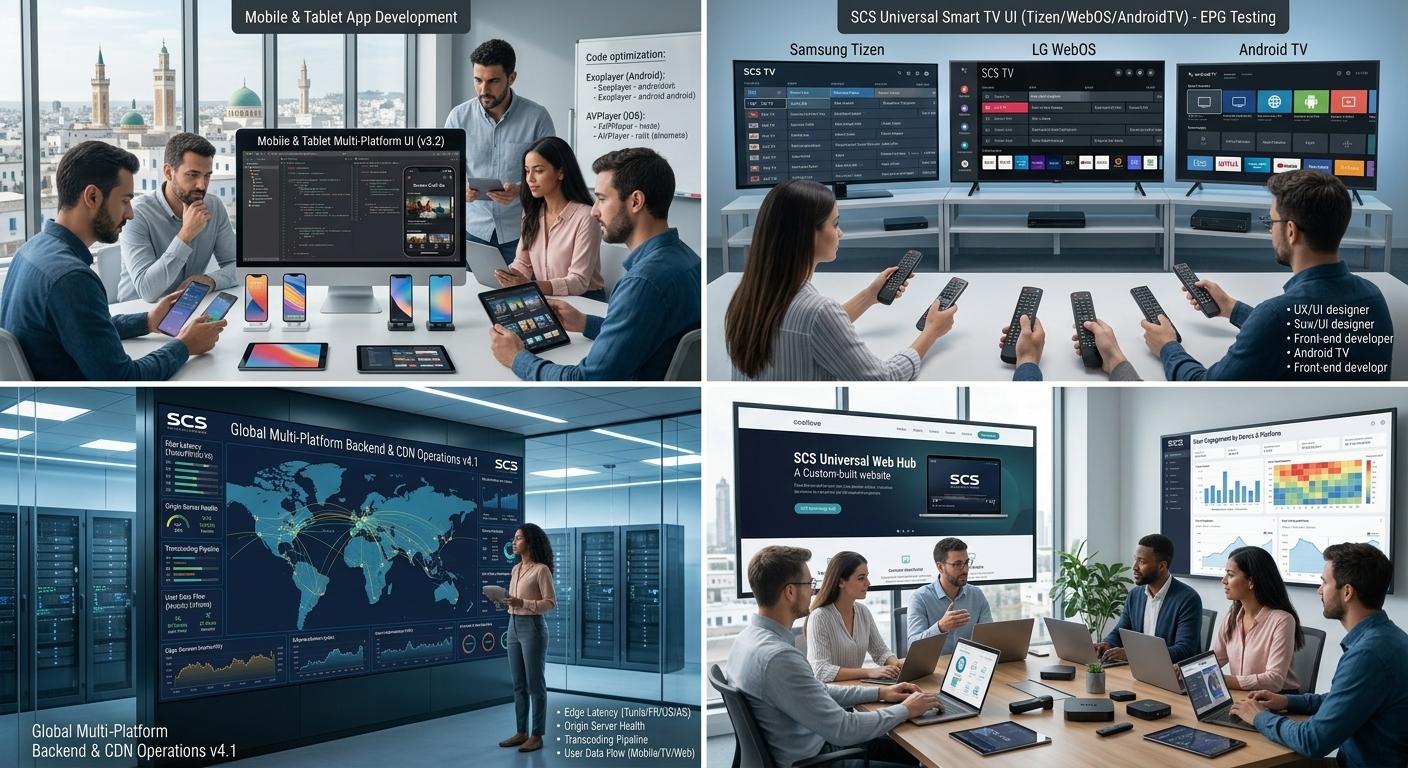
Running a commercial IPTV or pay-TV service involves orchestrating two distinct planes: a media data plane (broadcast ingest, transcoding, playout, origin packaging, and CDN edge delivery) and a control plane governed by IPTV middleware. When operators bolt disconnected billing scripts onto fragile set-top box (STB) APKs, channel zapping slows down, stolen stream URLs leak within hours, and firmware updates brick field hardware.
This systems guide details how modern IPTV middleware connects billing, EPG, broadcast playout software, and client apps across Smart TVs, Android TV Operator Tier boxes, and IPTV streaming applications.
How Modern IPTV Middleware Connects Billing, EPG, Playout & Smart TV Clients
Think of IPTV middleware as the authoritative nervous system between operator operations and every viewing device. Rather than embedding channel URLs, subscription logic, or DRM rules inside client apps, the middleware exposes low-latency, cache-tiered APIs backed by PostgreSQL, Redis, and asynchronous event workers.
| Middleware Subsystem | Upstream Integration | Core Responsibility | Downstream Output to Clients |
|---|
| Subscriber & Billing Sync | Stripe, telco BSS/OSS, CRM | Plans, add-on bouquets, grace periods, MAC/device binding | JWT entitlement claims & bouquet IDs |
| EPG & Metadata Pipeline | XMLTV, Gracenote, TVA | Normalize timezones, artwork, catch-up windows & series IDs | Compressed JSON/GraphQL 7-day grid slices |
| Playout & Catch-up Sync | Broadcast playout & SCTE-35 | Track live schedule transitions, time-shift & NPVR windows | Instant start-over & DVR asset URIs |
| Session & Concurrency Gate | Client heartbeats & Redis | Enforce max simultaneous streams per household plan | Playback authorization or 409 stream-limit UX |
| Operator Console & Fleet Ops | NOC / support teams | Channel health, instant user revocation, OTA rollout rings | Live diagnostics & targeted forced refresh |
High-Availability Control-Plane Pattern
- ✓Decouple Auth from Playback: Separate /v1/auth/device-login from /v1/playback/authorize. Edge-cache catalog and EPG responses in CDN/Redis so 100,000 subscribers booting STBs at 20:00 for a live match never hammer PostgreSQL joins.
- ✓Real-Time Playout & EPG Hooks: Connect your broadcast playout software directly to middleware webhooks so last-minute live schedule overruns automatically extend catch-up/NPVR recording boundaries and update client program cards without waiting for midnight XMLTV cron jobs.
- ✓Graceful Degradation: Issue signed offline catalog snapshots with short TTLs and keep active stream authorization stateless at the CDN edge while reserving Redis writes for session heartbeats and device-limit revocation.
Explore our dedicated IPTV middleware engineering scope and IPTV application development services to see how these APIs power Smart TV, web, and mobile clients from one schema.
Set-Top Box (STB) & Android TV Operator Tier Software Development
Operators deploying managed hardware face a clear choice between AOSP / Linux WebKit STBs (common in hospitality and legacy cable replacements) and Google-certified Android TV Operator Tier hardware engineered with an Android TV system integrator.
Android TV Operator Tier Architecture
Unlike standard Google Play retail apps, Android TV Operator Tier lets broadband and pay-TV operators own the living-room home screen from cold boot:
- ✓Custom Operator Tier Launcher: Replace the generic Android TV launcher with a branded UI showcasing live TV channels, operator VOD rows, SVOD partner deep links, and subscriber account notifications directly at boot.
- ✓TV Input Framework (TIF) Integration: Implement TvInputService so hybrid DVB-C/S/T broadcast tuners and IP multicast/ABR streams share one unified channel list, instant hardware-accelerated zapping, and native Live Channels EPG behavior.
- ✓Hardware Media3 & Widevine L1 HAL: Leverage OEM-certified SoC pipelines (Amlogic, Broadcom, Realtek) for 4K 60fps HEVC/AV1 decoding, Dolby Audio passthrough, and Widevine Level 1 TEE hardware decryption.
- ✓Zero-Touch Provisioning & TR-069 / OTA Management: Authenticate boxes automatically via hardware serial + MAC/Provisioning Server upon first Ethernet/Wi-Fi connection, with staged OTA firmware rings and remote crash/thermal telemetry.
Linux / Embedded STB & AOSP Alternatives
When operators manage closed hospitality networks, private enterprise IPTV, or cost-sensitive custom hardware outside Google GMS licensing, set-top box software development relies on hardened AOSP builds or embedded Linux (RDK / WPE WebKit / Qt) clients communicating with the exact same REST/WebSocket middleware contracts. Building cleanly abstracted client playback adapters ensures your operator backend supports Android TV Operator Tier, retail Smart TVs, and legacy Linux STBs simultaneously. Review our Android TV app development solutions for Media3, Leanback, and STB integration specifics.
Multi-DRM Security (Widevine, FairPlay, PlayReady) & Anti-Piracy Tokenization
Content studios, sports leagues, and regional broadcasters will not license premium feeds without a verifiable IPTV DRM solution that protects both the encrypted media segments and the CDN delivery perimeter. Relying on simple IP locks or static M3U playlists invites immediate credential sharing and restreaming.
Defense-in-Depth Streaming Security Stack
- ✓Unified CPIX Multi-DRM Packaging: Encrypt CMAF (cbcs / cenc) segments once at the packager using CPIX (Content Protection Information Exchange) key rotation so one media ladder serves Google Widevine (Android TV, webOS, Chrome), Microsoft PlayReady (Samsung Tizen, Xbox, Edge), and Apple FairPlay Streaming (Apple TV tvOS, iOS, Safari).
- ✓Short-Lived HMAC / JWT Edge Tokenization: Every playback/authorize call validates subscriber entitlement, geo-IP compliance, and active concurrency slots before minting a time-bounded (e.g., 60–180 second) HMAC-SHA256 or asymmetric JWT token bound to the CDN manifest path and client session fingerprint.
- ✓Key Rotation & Instant Session Revocation: Rotate content keys on live channel intervals (e.g., every 15–30 minutes) and drop unauthorized device tokens immediately from Redis so revoked accounts lose decryption keys on the next segment boundary.
- ✓Session Watermarking & Device Attestation: For tier-1 live sports rights, pair Play Integrity / Apple App Attest checks during license acquisition with A/B-variant server-side or client-side forensic watermarking to trace leaked restreams back to the exact compromised subscriber session.
Frequently Asked Questions
What is the role of IPTV middleware in a streaming or operator network?
IPTV middleware acts as the central control plane connecting subscriber management, billing, EPG ingestion, channel packages, catch-up/NPVR scheduling, and entitlement tokenization with Smart TV, mobile, and Set-Top Box client applications.
What is the difference between retail Android TV apps and Android TV Operator Tier STB development?
Retail Android TV apps install on consumer televisions via Google Play and follow standard launcher rules. Android TV Operator Tier provides telecom and pay-TV operators with a branded custom home launcher, deep TIF (TV Input Framework) hardware tuner/EPG integration, zero-touch provisioning, and remote fleet telemetry managed by an Android TV system integrator.
How do IPTV DRM solutions combine Multi-DRM with anti-piracy tokenization?
Production IPTV DRM solutions pair CPIX-synchronized Widevine, PlayReady, and FairPlay encryption at the packager with short-TTL HMAC/JWT signed playback URLs, concurrency session locks in Redis, geo-IP enforcement, and optional forensic watermarking for high-value live sports.
Does IPTV middleware replace broadcast playout software?
No. Broadcast playout software schedules linear video, live SRT/SDI switching, SCTE-35 ad markers, and graphics into continuous encoded streams, whereas IPTV middleware manages subscriber entitlements, XMLTV EPG metadata, and client playback authorization.
Architecting a new operator headend, custom STB fleet, or Multi-DRM streaming network? Connect with our engineering team via IPTV application development, Android TV & STB systems, or broadcast playout solutions, or schedule an architecture call.